Saint Irenaeus, Against Heresies
-
- Saint Irenaeus, Against Heresies - Part 1 | Books I and II
- Saint Irenaeus, Against Heresies - Part 2 | Books III and IV
- Saint Ir...
Althod
-
ORTHODOXY OR DEATH!
*ECUMENISM -- A PATH TO PERDITION*
___________________________________________________________________________
ORTHODOXY OR DEATH! ...
The Parousia of 'Isa al-Maseeh
-
Views from a hill
Golgotha today. The hill where Christ was crucified and not far is the tomb
He rose from on the first Easter.
What He sees today is...
The synagogue of Satan will not change
-
*The synagogue of Satan will not change, when they are brought and made to
prostrate themselves before God and His Christ and their faithful in
Christ, th...
JESUS CHRIST IS THE ONLY WAY AND TRUTH AND LIFE - NO ONE COMES TO THE FATHER EXCEPT BY HIM.
For as it was not possible that the man who had once for all been conquered, and who had been destroyed through disobedience, could reform himself, and obtain the prize of victory; and as it was also impossible that he could attain to salvation who had fallen under the power of sin,-the Son effected both these things, being the Word of God, descending from the Father, becoming incarnate, stooping low, even to death, and consummating the arranged plan of our salvation, upon whom [Paul], exhorting us unhesitatingly to believe, again says, "Who shall ascend into heaven? that is, to bring down Christ; or who shall descend into the deep? that is, to liberate Christ again from the dead." Then he continues, "If thou shall confess with thy mouth the Lord Jesus, and shalt believe in thine heart that God hath raised Him from the dead, thou shall be saved." And he renders the reason why the Son of God did these things, saying, "For to this end Christ both lived, and died, and revived, that He might rule over the living and the dead." And again, writing to the Corinthians, he declares, "But we preach Christ Jesus crucified; "and adds, "The cup of blessing which we bless, is it not the communion of the blood of Christ? " - St. Irenaeus, Against Heresies, Book III, Chapter XVIII, Section 2.
The Crucifixion of the Lord Jesus Christ, Mary and John and the women at the foot of the Cross
Matthew 27:45 Now from the sixth hour, there was darkness over all the earth, until the ninth hour.
Origen tell us this darkness was only in Palestine, and the neighbouring countries: for as to the words, over the whole earth, or over the whole land, we find one kingdom or empire, by a common way of speaking, called the whole earth, or the whole world. As to the cause of the obscuration of the sun; and secondly, as to the extent of its darkness. Origen tells us that the darkness was partial, and confined to Judea and the neighbouring countries, as the darkness of Egypt was only perceived in that country, and not in Gessen, where the children of Israel were. Saint Jerome tells us that the obscurity was caused by the rays of the sun being suddenly withdrawn by divine power, as was the case in Egypt. The darkness in Egypt during the Passover of Moses was due to God's protection withdrawn from that land at that time. The darkness when Christ was Crucified for us is the judgement of God upon His Son Jesus Christ, in our place. For Jesus Christ knew NO sin. He never sinned, nor could He ever.
The meaning of the Pasch of Christians.
The Book of Wisdom, Chapter 17, describes the devils and demons thrown back upon the Egyptians when the Israelites under Moses were brought out of Egypt by God for God’s purposes (to prepare a place for the Crucifixion of Our Lord for the Redemption of the whole world of those who are saved). In the same way the same false gods and goddesses that the Egyptians served and which in so doing were the reason the Egyptians sacrificed their sons and daughters to the devils and demons behind the false gods/goddesses were the spirits that killed the Egyptian children that perished when the Israelites were brought out of Egypt. God does not murder children, period. The angel of death which destroyed in Egypt was one of the fallen spirits. God did not cause any of the fallen spirits to hurt anyone. God allowed the fallen spirits to do what it is their nature do to when He brought the Israelites out of the gates of hell which was Egypt. The children below the age of reason that died went to be with God for eternity, they will be resurrected with the just at the Second Coming of Christ. This principle of God allowing the innocent to be afflicted along with guilty finds its ultimate fulfillment in Christ’s singular and only salvific Kenosis. Jesus Christ committed no sin, not ever nor could He, and was and is and only could be utterly and absolutely and completely innocent of any and all wrongdoing and sin by His very nature as the Holy and True God. The guiltless sacrificed by His own will for the guilty. Even when the innocent are afflicted by the actions and evils instigated by the fallen spirits in the world, the innocent are not possessed by those fallen spirits. The principle of all being afflicted by the evil set loose upon the world for its unrepentant sin will occur when the universal plagues are let loose upon the world. See Apocalypse 16 –
The principle of our always, for our part, protecting children is given us by Our Lord and Saviour Jesus Christ in the Gospel of Matthew, Chapter 18
1 At *that hour the disciples came to Jesus, saying: Who, thinkest thou, is the greater in the kingdom of heaven?
2 *And Jesus calling unto him a little child, set him in the midst of them,
3 And said: Amen I say unto you, *unless you be converted, and become as little children, you shall not enter into the kingdom of heaven.
4 Whosoever therefore shall humble himself as this little child, he is the greater in the kingdom of heaven.
5 And he that shall receive one such little child in my name, receiveth me.
10 Take heed that you despise not one of these little ones: for I say to you, *that their angels in heaven always see the face of my Father who is in heaven.
The principle of our ONLY worshipping the True God, the Father and the Son Jesus Christ and the Holy Spirit is given first in the historical truth of the Garden of Eden when Christ, who is the Tree of Life commands the first man and his wife, Adam and Eve to not have anything to do with the tree of the knowledge of good and evil which is Satan, the first fallen angel, nor with any of the fallen angels with Satan. Assisi of Babylon/Vatican/Rome is absolute and complete violation of that principle and is the Great Apostasy in full blown Satanic evil. Have nothing to do with the Vatican or suffer its eternal damnation in hell with it. The devil and demon worshipping pagans and the perfidious deicidal Jews are not ever any part of the Salvific action of Christ upon Golgotha/Calvary. Individual pagans and Jews if they repent of their not confessing Jesus Christ as the Immortal Son of God become flesh for our sake and sacrificed for our salvation and who confess publicly their sin of devil and demon worshipping and perfidy and deicide and who beg the Lord of all, the Lord God, the Father and the Son Jesus Christ and the Holy Spirit for forgiveness of their horrid and abominable sins, can and will be forgiven if they do so now in this life and will enter into the only path of salvation there is as dictated by God Himself. The Church, all the faithful – there is no other meaning acceptable to God for the word Church, is commanded by God to not have anything to do with the Apostasy.
Book of Wisdom, Chapter 17
1 For thy judgments, O Lord, are great, and thy words cannot be expressed: therefore undisciplined souls have erred.
2 For while the wicked thought to be able to have dominion over the holy nation, they themselves being fettered with the bonds of darkness, and a long night, shut up in their houses, lay there exiled from the eternal providence.
3 And while they thought to lie hid in their obscure sins, they were scattered under a dark veil of forgetfulness, being horribly afraid and troubled with exceeding great astonishment.
4 For neither did the den that held them, keep them from fear: for noises coming down troubled them, and sad visions appearing to them, affrighted them.
5 And no power of fire could give them light, neither could the bright flames of the stars enlighten that horrible night.
6 But there appeared to them a sudden fire, very dreadful: and being struck with the fear of that face, which was not seen, they thought the things which they saw to be worse:
7 And the delusions of their magic art were put down, and their boasting of wisdom was reproachfully rebuked.
8 For they who promised to drive away fears and troubles from a sick soul, were sick themselves of a fear worthy to be laughed at.
9 For though no terrible thing disturbed them: yet being scared with the passing by of beasts, and hissing of serpents, they died for fear: and denying that they saw the air, which could by no means be avoided.
10 For whereas wickedness is fearful, it beareth witness of its condemnation: for a troubled conscience always forecasteth grievous things.
11 For fear is nothing else but a yielding up of the succours from thought.
12 And while there is less expectation from within, the greater doth it count the ignorance of that cause which bringeth the torment.
13 But they that during that night, in which nothing could be done, and which came upon them from the lowest and deepest hell, slept the same sleep.
14 Were sometimes molested with the fear of monsters, sometimes fainted away, their soul failing them: for a sudden and unlooked for fear was come upon them.
15 Moreover if any of them had fallen down, he was kept shut up in prison without irons.
16 For if any one were a husbandman, or a shepherd, or a labourer in the field, and was suddenly overtaken, he endured a necessity from which he could not fly.
17 For they were all bound together with one chain of darkness. Whether it were a whistling wind, or the melodious voice of birds, among the spreading branches of trees, or a fall of water running down with violence,
18 Or the mighty noise of stones tumbling down, or the running that could not be seen of beasts playing together, or the roaring voice of wild beasts, or a rebounding echo from the highest mountains: these things made them to swoon for fear.
19 For the whole world was enlightened with a clear light, and none were hindered in their labours.
20 But over them only was spread a heavy night, an image of that darkness which was to come upon them. But they were to themselves more grievous than the darkness.
Chelli is a woman in her late twenties, a US citizen and a dissident. Two days later, she wrote me some of her memories from my homeland Hebron. She said: I wanted to give some of the beautiful moments I remember well from Tel Rumeida, the Palestinian historical area over the highest hill in center of the occupied city of Hebron.
[use Open Image in New Window to see pictures in full enlarged]
Abu Aisha children living in a cage directly across the street from the colonial “Ramot Yishai” settlement in Tel Rumeida in Hebron.
The first long period I was in Tel Rumeida in 2005, we had been working there for some months, and every morning we would go and take our places in the streets, near Qurtaba primary school for girls and near the squatters colony of the so-called “Beit Hadassah” on Al-Shuhada Street, near the military checkpoint at the entrance of the street, and at the top of the first stretch of the hill in the street, where it evens out below the so called “Ramot Yishai”.
On this morning, I had just gotten up and was walking from our apartment where we lived above the Palestinian family of Abu Ghassan Abu Aisha’s home. I turned the corner to go down the hill to Al-Shuhada and saw Hamzi, a young man whom we all very much loved and appreciated for his good spirit, helpfulness, and kindness. He was, from a young age, a very great man. I saw him and said good morning. He laughed, and said to me, in Arabic, “Congratulations on changing your clothes”. I looked at him in astonishment. It’s true, I often wear the same thing day after day. I couldn’t believe he had noticed! I laughed and ducked my head in slight embarrassment which caused him even more glee …
I remember visiting the home of three little girls: Roba, Sarah, and Ala, three Palestinian girls I loved them because they were adorable, and also because they all shared with their mother a gravelly voice. At that time, they were young, between the ages of four and seven. I came to their home, and asked: “Where is Roba?” She was the youngest and super cute. Her father looked under the sofa and saw her sleeping there. He pulled her out against my protestations and stood her up, straight from full slumber. He encouraged her to greet me, which she did while rubbing her eyes. I remember later that visit she played on my knees, leaning on them and swinging on them.
I remember looking at the colonial Israeli settlement, the so-called “Ramot Yishai” imposing itself on the city, from our apartment which had a full and unobstructed view of the back side, above the Azzeh homes. I watched it many times and filmed their attacks. On this day I observed the settler children. They wandered around bored, listless. They sat on their swing. They did not pretend or play or laugh. Adults wandered around, talking on cell phones. They did not greet the children. I observed that actually I had never seen the settler children playing pretend.
“In this footage two Israeli settler boys repeatedly throw rocks at the Abu Aisha family’s home directly across the street from the colonial settlement at Tel Rumeida . This family has built a steel cage over the facade of their home in order to minimize damage from ongoing settler terror, and to try to keep themselves safe when entering and exiting their home. You will notice that the colonial settlers are using pieces of an ancient archeological site, a historical place listed as a UNESCO World Heritage site, to stone the Abu Aisha home.”
I then wandered to the front of the apartment, looking over the area near Bassem Abu Aisha’s home. I saw his young son, about three or four years old, sitting on the curb with another young friend. They were playing with dirt, which they began to throw over their heads, yelling “Opa!” I laughed at this, and later made it a point to mention it to his parents, probably on a few occasions, how cute their son was, and how joyful his play.
I remember the first time I was there for a long time, and Ramadan came. Kids asked me everyday if I was fasting, and I had just come from eating something… And I’d sort of chuckle and say in Arabic, “Yaani….” that means perhaps.
Kill Arabs! - European Colonist Graffiti near Tel Rumeida. What sentence would these disgusting racists get in their home countries for such incitements to murder?
We were very busy during this time, and much was happening. I was feeling exhausted and had been visiting homes on many very nice occasions for celebrations. On this day, I felt I needed some rest at the end of our day in the streets. Just then, on Shuhada Street, Hamdi, a man I knew, invited me to his extended family’s home for a large celebration. I tried to apologize and refuse, but he insisted strongly. I then…. sent two others along in my place with my apologies (though they didn’t speak Arabic, nor he English), and didn’t go. I saw him two days later on the stairs to Qurtuba, where he shouted at me, “You are not correct!” I couldn’t help laughing a little and apologized a lot. I celebrated with them a few days later and our good relations remained intact.
Die Arab Sand Niggers! Graffitti from the European colonists at house of Adel Sammouh's house near Qurtoba school!
I remember an old woman (il haji) that lived in Al-Shuhada St. I cannot remember her name, but she is a great woman. She often locked her door and then returned, sometimes a few times, to check to make sure it was locked. I loved many of the people on that stretch of Al-Shuhada, where I spent a lot of my days. Musa, il haj. The Al-Bayyid family, Reheia, the mother, and her sons. One time Musa told me that the haji was an extremely beautiful woman in her youth, known for it. He then called over to her,”Did you hear what I said?” and told her in Arabic. She chuckled and then insisted he stop, looking around in mock fear of the young men who might overhear and descend upon her. She shared tea with us this day and we drank in the street.
by Kawther Salam
Possibly related posts (automatically generated):
A Memory from my Childhood I was born to a simple, poor family. I am one daughter among five sisters and three brothers. My father...
The Petroleum Lamps We were lucky; we had two petroleum lamps in our home. I remember these two lamps. One of them hanged...
From Mary Jacobs I do not know if you are a sharamit (Note: she probably means “Sharmuta”, the Arabic and Hebrew word for...
UNRWA Relief These are my memories of the “humanitarian relief” of the UNRWA after the Palestinian Naqba. I was between 6 and...
Gadi Shamni Gadi Shamni during a tour of Hebron, in 1996 or 1997 (click photo). In Hebron, my homeland, I met Major...
Eight years ago I visited Dublin to help in the preparation of the Conference of Human Rights Defenders. I stayed in Dublin for more than two months. When I went back to my homeland Palestine, I faced tough charges and was subjected to a relentless campaign of brutality and oppression by the Israeli occupation, which ended by myself being thrown out of my home country of Palestine. I do not want to remember the rest of this tragic story at least while I am writing this short report on Dublin, the capital of the lovely and peaceful State of Ireland.
Eight years after my first visit, I attended the ARABMED medical conference there. The heritage, culture, civilization of Ireland and its historical struggle for independence, the art and generosity of its friendly people stole me of myself and the conference. I found myself small before this country, their culture and the incredible friendliness of its people despite their centuries old history of struggle against occupation.
On Saturday Nov. 30 2010, I toured the city on foot. After I visited Trinity College, I spontaneously went to Templebar / Fleet Street, where I had spent ten days in a room B&B at Oliver St. John Gogartys Pub before I moved to live in Dublin 6 during my visit 8 years ago.
Templebar / Fleet Street is one of the most traditional historical streets in the center of Dublin, where many clubs and trendy pre-club bars get the Irish youth and the tourists in the mood for the night life of dancing and drinking the famous Guinness beer. The Templebar / Fleet Street, is located in the center of Dublin. The famous Temple Bar Hotel is located in the same street and about 100 meters from the River Liffey. In the Templebar area of The Fleet St. there are many pubs, cafés, restaurants, and always people are coming and going among the many different nightclubs, they are smiling, dancing, drinking, meeting friends and celebrating their personal parties.
The Templebar starts with restaurants and unusual shops which line these narrow, cobbled streets running between the Bank of Ireland and huge Christ Church Cathedral (Cathedral of the Holy Trinity) where the sky smiles at you (when it is not raining) while touring this historical holy place, which was founded sometime after 1028 when King Sitric Silkenbeard, the Norse King of Dublin, made a pilgrimage to Rome. Read more about the Christ Church Cathedral
When I visited the accommodation where I spent some days in 2002, I remembered that I was not able to sleep at night because of the huge happiness of the night life around me, which turned my nights into days, making me sleepy during the day. Nothing had changed in this accommodation, even the prices of the night stayed as they were 8 years ago, 12 Euros per night.
The walls and fortifications about Dublin were raised by the Danes in the 9th century. It was the head and capital of their colonies in Leinster, which they fortified to defend themselves from their enemies. Read more.
In the 18th century the area of the Temple Bar was home to many insalubrious characters and brothels. It was also the birthplace of the parliamentarian Henry Grattan. Skilled craftsmen and artisans, such as clockmakers and printers, who lived and worked around Temple Bar until post-war industrialization led to a decline in the area’s fortunes.
According to the information which I received from a tourist office, in the 1970s, the national transport authority bought up parcels of land in Temple Bar area to build a major bus depot. The area became the city’s “officially designated arts zone”. Culture mixed with heritage, arts and civilization. Around the street dozens of galleries, centers for music, multi-media and photography, Cultural Centres, etc. coexist.
Walking around the Temple Bar is something special where you could easily reach nearby landmarks such as Grafton Street, Trinity College, The Guinness Brewery and Dublin castle, Dublin city wall, shops, and enjoys looking at galleries, theaters. From the other side you could reach Christ Church Cathedral, St. Stephen’s Green, Patrick’s Cathedral and other important and historical sites of Ireland. Each entry it takes you to a new site and a new story and historical world.
During the same walking tour, I visited various historic buildings, among others the Christ Church Cathedral and Patrick’s Cathedral, which is considered as the largest and most beautiful church in Dublin.
While walking I shot a picture of a sign of “Enjoy yourself!! Enjoy Guinness”. These two sentences where written by hand on the Market Street wall near the Guinness Storehouse, the most important features of Dublin which attracts many tourists. After a long walking tour, when darkness started spreading its curtain over the city, I remembered that I was hungry and went home to eat. The Irish people are fond of Guinness. With Guinness at the end of the day, they live, smile, dance and forget the troubles of a long day of work.
What I saw during the hours of my tour is more than my words could explain and more than what I saw during my previous visit and stay in Ireland in 2002. During this tour, the history of county was my main interest. In 2002, my ONLY interest was exposing the criminality of the Israeli occupation. Now, I preferred walking and talking to the friendly Irish people. Dublin has a center of Tour Buses for tourists which have a design in yellow, red and different colors.
In my opinion making a tour of the city by bus does not really show the whole beauty of the place, so I got out of a group tour in a bus and went to explore the city on foot, which I found much more enjoyable than sitting in a bus. During this short tour I saw much beauty and many tourists. The Irish people told me that the economic situation is not good in the country which they love, that many people are engaged and work in London and they return home only for weekend. This shows clearly as on Monday morning there was huge traffic on the road to the airport because of the many Irish who must travel to their work in Britain.
by Kawther Salam
Possibly related posts (automatically generated):
The Petroleum Lamps We were lucky; we had two petroleum lamps in our home. I remember these two lamps. One of them hanged...
Vienna is the City of Culture Vienna is the City of culture, music, concerts, arts, theater, science, peace, beauty and love. Since my arrival to this...
Charges vs Israel From: william To: “kawther_salam [at] yahoo [dot] com” Cc: Sent: Thu, November 12, 2009 5:07:23...
Shmuel Hollander is the current (2010) Israeli civil service commissioner, a former cabinet secretary under Yitzhak Rabin and Shimon Peres, until after the elections of 1996.
Hollander is a lawyer by profession. Hollander studied law at the Hebrew University, graduating in 1970, but he practiced something else and implemented the military laws in his position as a major of the IDF between 1970 – 1973 . Some inhuman laws of the Othman Empire still exist ONLY in Israel and are implemented ONLY against Palestinians due to his work.
Hollander is a currently retired IDF soldier. He was a military prosecutor and a judge commander, this means that Hollander had knowledge of the IDF crimes in the occupied Palestinian territories, and that he defended and covered them up.
Hollander had over the years in various legal counsel positions:
From 1973 – 1985, Hollander served as deputy attorney general office state comptroller.
From 1982 – 1984, he served as a representative of the Jewish Agency in the United States. From 1986 – 1992, Hollander served as general counsel of the Civil Service Commission. From 1992 – 1994, he served as legal advisor to the Prime Minister’s Office.
Hollander was born on August 2 1946 in Czechoslovakia. He immigrated to Israel in 1949.
On November 1 1996 Hollander was appointed Civil Service Commissioner, a position in which he serves to this day, August 2010.
Hollander posted many zionists settlers in their civil posts at the so called civil administration, a branch of the IDF central command in the occupied territories. These extremists were engaged by temporary contract but Hollander turned them into permanent ones.For example David Kishik, a zionist squatter from the Kochav Hashar squatter colony who is the son of former prostitute Shula Cohen, a criminal and thieve who was involved in various corruption stories involving the looting the civil administration budget, issuing licenses for the establishment of stone crushing plants in the occupied territories in return for his mother and his wife to be partners in these projects.
David Kishik received his post with the help of Hollander. Strictly according to law, these projects implemented with the help of Hollander constitute plunder, thus Hollander is culpable and liable to prosecution for war crimes. See more documents about David Kishik.
Hollander was supposed to step down from his position, but his tenure was extended for four months. Hollander is married and has four children.
On August 23 2010, I sent Hollander a letter about Daniel Seaman, a dictator who I was forced to meet during my work as journalist in Palestine. My memories about Seaman are full of tragedies and crimes committed by this dictator against the Palestinian foreign journalists. Those crimes are still etched in my mind just as if they had happened yesterday. The first of August 2010 was the beginning of my eighth years in the exile. On this unhappy anniversary which reminds me of the brutal Daniel Seaman, the IDF criminal soldiers and the Israeli occupation. See more documents. Below is my letter.
August 23, 2010
To: Shmuel Hollander, Office of the Civil Service, 3 Kaplan Street, Street, Jerusalem Kirya, Zip 91340
From: Kawther Salam
Subject: Daniel “Danny” Seaman, director of the Israeli Government Press Office (GPO).
Hello Mr. Hollander,
I am writing to you in reference of Daniel Seaman, director of the Government Press Office and responsible for uncounted violations of the principles of journalism, infringement on the freedom of movement and work of many colleagues. Seaman continually misused his position and the political situation to take “revenge” against Palestinian journalists in order to satisfy his hatred born out of bigotry, petty vindictiveness against people who could not defend themselves. I am one of his many victims.
In addition to his well-known continued mistreatment, abuse and slurs against Palestinian and foreign journalists, it is also suspected that Seaman might have had a direct role by way of incitement in the shootings of various colleagues as well as of human rights workers from abroad who were working in Palestine, among them are Fadel Shana, James Miller, Nazih Darwazeh, Raffaele Ciriello, and many others.
In my own case, Seaman misused his position as a director of the GPO to threaten and insult me, accusing as of being a “hostile journalist”, refusing to renew my press card and informing the extremists jewish squatters and the IDF soldiers about this and demanding that they prevent me from going after my work in my homeland Hebron under the Israeli occupation, that they end my journalistic work in Israel and Palestine, dragging me into shameless fight, legal confrontation and creating an atmosphere of hostile international public opinion against the Israel.
The details of this story are rooted in the year 2001, when Mr. Seaman refused the renewal of my permanent GPO press card number 120097. I was at that time a reporter in the occupied territories and Israel working with the Israeli newspaper Al-Ittihad in Haifa, and the Sunday Tribune in Ireland.
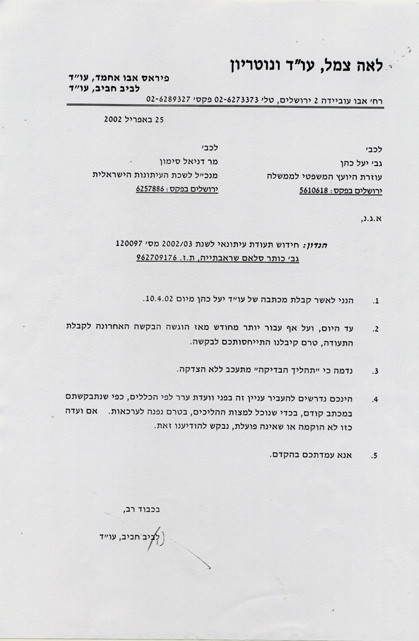
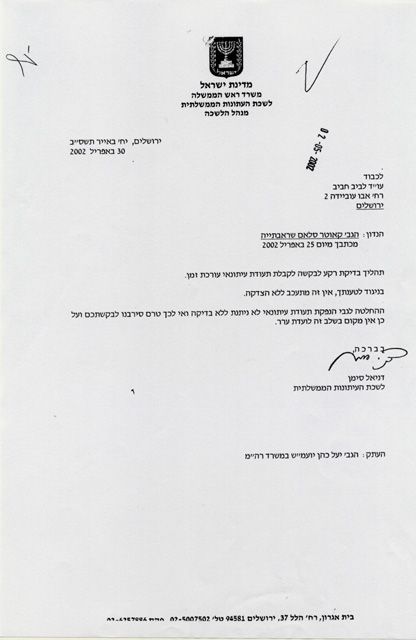
On November 5 2001 I met Seaman in his office and asked him to give me the form for applying for the renewal of my Press Card which would lapse at the end of 2001. Instead to give the GPO form, Seaman went into a shocking tirade, confronting me very aggressively with foul and abusive language, and ending his freak-out by throwing me out of his office and accusing me of “working with hostile media”. (Click on the pictures to see them bigger).
Seaman told me that he had received a letter from the “settlers”, criminal jewish squatters who live in my homeland Hebron where they demanded that he end my GPO press card. Seaman also told me that the IDF soldiers did not like my journalistic work in Hebron and that he would not give me a form for renewing my press card.
Seaman also told me that I was “a journalist who wants to use the GPO card as a pass for free movement in Hebron and Israel in order to report in hostile media”, and that he wouldn’t allow that. When I tried to clarify my position and defend myself, Seaman went into a tirade accusing me of being a hostile journalist and describing me, in his own words as “חצוף” and an “enemy of the IDF soldiers and the Jewish community” and insisting that I should not forget that “he is a colonel and a soldier and he would not allow me to harm the IDF with my hostile journalism”.
Seaman was not right in his accusations. I have worked as a journalist since 1984; I never had security problems with Israel. In my family there was and still there is nobody involved in any way in politics or belongs to any political faction. As a journalist as well as personally, I worked hard to support the peace process and to defend the human rights of everybody.
In 2001 I found a jewish child lost in a Palestinian neighborhood in Hebron which was under intensive curfew, and I returned the child to the jewish squatter colony Avraham Avino, to same settlers who had several times stoned me and broken my cameras.
In January 2002 I published an appeal to Israel for the renewal of my Press Card in the Irish Times newspaper in Dublin. Mr. Aidan White, the Secretary General of the International Federation of Journalist (IFJ) also appealed to the Israel government for the renewal of my card. Lea Tsemel, an Israeli lawyer, wrote to the GPO on my behalf about the renewal form for my press card.
On March 6 2002 I was able to fill the form to apply for a renewal of my press card at the office of Dr. Fawaz Kamal, the director of the Arabic department at the GPO office. Mr. Kamal told me in a friendly way that Seaman would never renew my press card. He added that Seaman is a stubborn man and that I had put my head against his head. He blamed me for reporting about this issue in the international media (the Irish Times) and claiming that Seaman would insists in challenging me.
In February 2002, Seaman threatened to arrest me if I was seen visiting the GPO to ask about my press card. He said that I would be “the last journalist in the world whose press card he would renew” and he topped that with personal insults, curses and other more than impolite suggestions. He said that “the terrorists who I deal with should help me to work without the GPO”. He added that “Israel does not need to see terrorist journalists”. He recommended me to never to call him again because he was sure that the intelligence “Shin Beit” would not approve the renewal my press card. Actually Seaman himself was the person who provided the Shin Beit with negative information against journalists.
Seaman informed the IDF spokesperson and the jewish squatters about his refusal to renew my press card. He caused me security problems, trouble with the IDF soldiers and the squatters. The soldiers expelled me from my house in Hebron. Due to his intervention I was victim of all kind of harassment at the hands of the IDF soldiers and the criminal squatters, and I lost my work as a journalist in the occupied territories and Israel, I lost my house, I live as a refugee in Europe far away from my beloved family, friends and my homeland.
In April 2002 Seaman cursed me in front of Mr. Joe Stritch, a jewish editor who worked with the AFP. He told him that he hated to hear my name and anybody asking him about me. Joe said that Seaman raised his voice and spoke in an angry tone to him. He said that Seaman described me as a “bitch” when Joe interceded in my favour to give me a temporary press card. Joe added that he felt that Seaman hated me very much: Seaman had stated that he wished me “a disaster”. Strich asked Seaman to give me a temporary GPO permit to help him to cover the IDF invasion and massacre of Jenin.
I have decided to submit this open letter to your office not because I need anything from the GPO after eight years of living in the exile, but because I still suffer deeply of the mistreatment by Seaman, his obscene and foul language, the filthy words with which he accused me of terrorism and hostile work, ending my journalistic work in my homeland and inciting the IDF soldiers against me. Seaman misused his power as director of the GPO not only against me, but also to threaten many other journalists from foreign media and causing big damages on every level.
I ask you to open all the correspondence between the office of Seaman and my previous lawyer, so you can see for yourself how he comported himself in my case. I would also ask you to judge each and every word which I have written and which could be described from your point of view as “hostile” to Israel, to the account of Seaman. Each word I have published during the last eight years of living in the exile, far away from my homeland and my family, go back directly to Seaman. While I used to work on stories of mostly local interest when I lived in Palestine, today I write mostly of the issue and problem which Israel represents to everybody, not only Palestinians. This change in my work was brought on you by Seaman, it was not of my own accord that I changed how and what I write about.
Seaman with his bigotry and racist hatred has not only destroyed my life, but he succeeded in radically changing my views about Israel, about zionism and about jews at large. The years of exile have been a very educative experience, among other things they have shown me in all possible clarity that it is a supreme error to acquiesce to criminals or to let oneself be scared by bullies, or to remain silent in the face injustice.
Where I used to think that it would be in the best interest of everybody to strive for a peaceful co-existence, today I think that there is no possibility for any kind of peace with Israel because there is no will on side of the jews to any kind of just peace. Another important insight which I owe in the exile is that Israel has no true friends beyond the minority of criminals, sociopaths and corrupt politicians which exist in every society, and it is clear that Daniel Seaman would never allow somebody like me who at one point sincerely believed in peace with Israel, but who belongs to neither of these groups, to remain anywhere near Israel. Who will help Israel when these minorities are exposed and ousted from power everywhere? Not me and not anybody I know of.
Even where the actions of Daniel Seaman can not be qualified as outright criminal, his discharge of his duties as head of the GPO can be qualified as grossly irresponsible and incompetent. Not only in my case but with almost all Palestinian and foreign journalists, Seaman did everything possible to sow gratuitous conflict, to create enmities where none existed, to mistreat and insult people merely doing their job, to punish and abuse those who were in no position to defend themselves against his repeated outbreaks of pathological hatred.
Seaman more than anybody has contributed to destroy any semblance of a positive image which Israel could have had abroad in spite of the never ending criminal rampage against us Palestinians because of his ill will, his attempts at dictating to journalists what and how to report, his abuse of the “Press Card” into an instrument of coercion against any journalist or medium whom he didn’t like, and lets not forget the brain-dead attempts of the GPO to extend its censorship to the Internet or the stream of lies which ensued after the Mavi Marmara atrocity, they were products of Seaman’s GPO.
With Seaman, Israel has brutish and bloodthirsty thug in a position where such people are met with disdain, and his lack of acceptance among the people with whom he must deal on a daily basis, journalists, reflects in his demeanor and in his lacking achievements. Since Seaman has no provable successes to talk about in the exercise of his duties, he is forced to resort to increasingly uncouth and abusive behavior to silence critics.
I reserve the right to take legal action against Seaman in accordance wien, August 21 2010.with the provisions of national and international laws at the first opportunity which presents itself. On the account of Seaman are not only my own case and the cases of many other journalists, but also the suspicion of being involved in the murders of many exiled Palestinians throughout Europe, and on murder and state-sponsored terrorism there is no statute of limitations, anywhere.
Yours truly,
Kawther Salam
Who is Danny Seaman? Who is Daniel Seaman? Who is Dani Siman? Who is Danny Seaman the extremist colonel who works with both Right and Left-wing Israeli governments? What is the secret behind keeping Seaman in his position as the head of the Israeli press office GPO for over ten years?
Overall, the adjudication of civil and the military posts in Israel are based on staff changes every two years, three or four years maximum. The former directors of the GPO were changed by these usual changes which came with changes in the Israeli governments. But Seaman, who has proved to be the wrong person for the job and position which he occupies, who has offended Israel with his rude behavior while treating foreign journalists in an improper, brutal ways, is suspected of being involved in corruption for the benefit of the Likud Party, has been able to keep his post for more than ten years. Seaman, who caused me eight years of suffering of living in exile, appears to have much more power than anyone in the Israeli government who would like to get rid of him.
Only the Israeli “Shin Bet” and the Mossad know from where Seaman draws his strength, power and sources of support.
by Kawther Salam
Possibly related posts (automatically generated):
About After I was forced by the Israeli occupation forces to leave my home Hebron in Palestine, I fled to Vienna,...
Is Daniel Seaman Israels Chief Torturer ? Last Sunday I posted an article about Daniel Seaman, the current head of the Israeli Government Press Office. While looking...
I received the text which follows from Ms. Hanna Braun, who is now 82 years old. She was born to a jewish family from Germany, a family which emigrated to Palestine in 1937 due to the increasing animosity against jews in Germany of that time. In her memories which Ms. Braun shares, she remembers the time during which she and her family lived in Palestine between their arrival in 1937 and until their emigration to England in 1958 due to their disillusionment with zionism and Israel. The memories of Ms. Braun are telling because they show from a first-person perspective, how all the propaganda, everything which the zionists say about zionism and Israel, does simply not correspond to truth, that “zionism” had and has nothing to do with “making the desert bloom”, that groups like Hagana were not about defense but about murdering and expelling Palestinians, that despite asseverations to the contrary Jews from Arab countries were lured to “Israel” under false pretexts. In short, the whole text is one scandal when compared with the zionist orthodoxy spread in western countries.
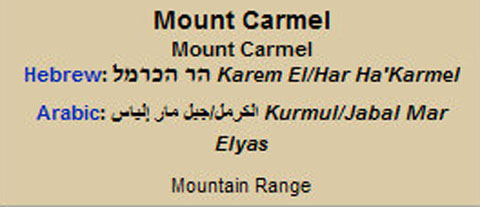
Becoming members of the Hagana involved a secret ceremony at night in a totally deserted spot on Mount Carmel, with torches and oaths of allegiance, something akin to what I imagine the Ku Klux Klan ceremonies were like.
“At the end of reading Hanna’s Braun memories, you are invited to see a short video: “I am Israel”. This video is not part of Hanna’s memories, it was submitted by another reader”.
Ms. Braun became involved in various zionist groups and activities, such as the Hagana, but became increasingly skeptical about the whole zionist project as time passed and she understood more and more what it really was about: grabbing from us Palestinians by any means necessary: terrorism, murder, guile … but read the whole text to see why this jewish lady became an anti-zionist.
From a sheltered middle-class early childhood in Germany with only nominal connections to Judaism, to active participation in the PSC, via a Zionist upbringing in Palestine, including membership of the “Hagana” and later the Israeli Defence Forces, seems a winding if not contradictory route to have travelled. I don’t believe this is, in fact, the case, but I’ll try to explain from scratch.
My family were not just German, but ridiculously proud North-Germans with a Buddenbrook (title of a novel by the German author Thomas Mann)-like disdain for South-Germans, Jewish or otherwise. Austrians and East Europeans were beyond the pale. Our assimilation into German society had become deeply ingrained over generations, with religion playing a derisory role. My first intimation of being Jewish came in 1933: that Easter I started school and my mother told me the previous evening that I would be asked to state my religion and was to answer “Jewish”, which, my mother assured me, was nothing to be ashamed of. Subsequent events soon proved otherwise: Hitler had come to power and most teachers increasingly railed against Jews in front of the class; some of the staff relegated us to one corner of the classroom and refused to teach us. “Click on the pictures to see them bigger”.
Within a couple of years our former good friends had stopped playing with us and would no longer invite us to their homes nor visit ours. Increasingly, we were excluded from public places of entertainment: theatres, concert halls and swimming establishments to name but a few.
To make matters worse, out went the Christmas tree and Easter Eggs; the alternative festivals of Hanukkah and Passover were not a patch on them! I remember concluding with a Jewish classmate that being Jewish was no big deal at all; in fact we heartily wished we weren’t! The actual peril of German Jewry was largely concealed from us, probably not least because Berlin being a large city, Jews, and particularly the very assimilated ones, were unlikely to be known or recognized as such.
However, there was an increasing exodus from Germany and we followed in 1937. Most of our circle of friends and acquaintances left for other European countries, including Britain, or for the USA. I fear the majority of my relatives were too short sighted to move at all, finding the idea of leaving Germany unimaginable till it was too late; most of them perished in concentration camps.
Why did we immigrate to Palestine? Certainly not because of Zionist ideals, particularly on my mother’s side; however, father had two siblings who had become early Zionists- still a rarity at the time amongst West European Jews although his family came from a far more traditional Transylvanian background- and had settled in Palestine around 1930. Their enthusiastic persuasion prevailed, not least after father explored the possibilities of finding a livelihood and was guaranteed secure employment with the British Mandatory Authorities as a specialist in electrical engineering (he had been working for Siemens).
And so we arrived at the port of Haifa on a beautifully clear and sunny morning in October 1937, in the midst of the second bitter Palestinian uprising, euphemistically termed “disturbances” by the British authorities and Jewish settlers alike. According to my newly acquired relatives who came to welcome us at the port, we had just missed a Khamseen, the hot, dry, wind from the Sahara. The word is Arabic for fifty, as the locals claimed this was the number of days per year we had it. This word has long since been translated to “Sharav”, as have numerous other Arabic terms and expressions in an effort to erase any possible connection between us and the Palestinians, let alone any hints that the Arab Palestinians had lived here long before us and knew more about climatic/geographical conditions.
At the time, the prevailing slogan was “Hebrew work for Hebrew workers”- translatable as a boycott of any dealings with, or employment of, Palestinian Arabs.
When my mother expressed amazement at this, asking how we were expecting to live in peace with the Arabs in such a way, our new relations regarded her with a mixture of pity and consternation – she wasn’t a proper Zionist at all! At the time this was certainly true: most West European Jews, especially the German ones, regarded Zionism as something for poor East European Jews who had trouble making ends meet. I still remember mother musing aloud after a visit to Arthur Ruppin, an early well known Zionist and a distant relation, “I don’t know why he became a Zionist; such a good family!” Years later mother was persuaded to Zionism, albeit a more humane version of a Bi-National State advocated by Professor Buber. The idea was soon marginalised and forgotten altogether.
The revolt (1936-1939) was aimed mainly at the British Mandatory Powers and at the new Jewish settlements that mushroomed continuously, often literally overnight. An old Ottoman law (still existing in Turkey) that allows a new settlement to remain legally in place once a watchtower and a fence are completed, was frequently used during nights by settlers on lands that either had not been fully documented as villagers knew the boundaries of their respective lands and saw no need to resort to official documentation, or via land sale by often absentee landlords.
One of numerous nationalistic songs from that period speaks of “the fence and the watchtower” another of “a dunum here and a dunum there” referring to the continuous land- grab in the country. We used to sing many such songs enthusiastically without ever questioning the glaringly obvious message it contained. Neither did most of us see the contradiction of living in Palestine as Palestinians yet simultaneously singing about our land of Israel in eternity. It was Lenin who coined the term “useful idiots” for blindly loyal followers of the Soviet regime. This term could have been specially tailored for us.
By that time (1937-1938) even the greediest of absentee landlords, often living in Beirut, had stopped selling land to the Jewish National Fund from underneath his tenants’ feet. Palestinian Arab fears of Jewish settler intentions had put increasing pressure on landowners, while such intentions were being completely denied by the Jewish community. We firmly believed that settlements, widely termed “Pioneer Settlements”, were developed on otherwise neglected and unused land, and lacked any understanding of indigenous people’s feelings: we were not taking their lands from them, or so the accepted wisdom went, but turning an arid land into a fruitful and productive one.
To that end, levies were paid on most goods and all public travel, not to mention the obligatory collection boxes in all shops, classrooms, restaurants, places of public entertainment and in many homes. Proceeds went to the Jewish National Fund and to the Settlement Fund. Money also came from Jewish communities in unoccupied Europe, the USA and various British colonies. Years later, in 1950 or 51, I was a Teachers’ Union delegate to some national conference in which a discussion took place on whether to continue these collections and levies, particularly in schools. I could not see the point, as by then we had a state and – so I naively believed – all the land we had wanted and more. I was outvoted by a large majority.
During my school years I became increasingly involved in the Zionist movement as well as the Socialist one, as indeed a large majority of young people were at the time, especially those who stayed on at school after the age of 14. We perceived no contradiction: we were combating colonialism in the shape of the British Authorities and our training, initially in unarmed combat, until most of us joined the underground “Hagana (Defence”) organisation, a year later. By that time the organisation, one of whose founders had been Moshe Dayan, had been outlawed by the British Authorities.
This made it doubly exciting for us youngsters. Becoming members of theHagana involved a secret ceremony at night in a totally deserted spot onMount Carmel, with torches and oaths of allegiance, something akin to what I imagine theKu Klux Klanceremonies were like. Following this, we started training to armed combat as well as in various endurance courses. It took me years to realise that any socialism that is exclusive to one people or group is a contradiction in terms, as is the idea of a democracy within a demographic context.
Most of our training took place over weekends at nearby Kibbutzim (collective farms), well away from the British Army or Police. Most Kibbutzim had at least some hidden caches.
I relished the difference between living in Germany and Palestine from the start: the freedom from restrictions, the absence of the stigma and anxiety of being a Jew and last but not least, the beauty of the country, its climate and the general air of informality, of a common aim and purpose and of discarding the shackles of an “old” traditional lifestyle for a new, confident and assertive one, captured my heart completely. With hindsight, I realize that many of these sentiments led to a sense of superiority, self-importance, arrogance and aggressiveness, characteristics that are still often found in Israelis nowadays and that have, indeed, increased; for youngsters growing up, however, this was heady stuff!
Most of us dreamt of a pioneering life as founding-members of a new kibbutz; we had experience of working and staying in established ones, very poor at that time, as volunteers during the long summer holidays as well as at weekends spent training in handling a variety of firearms. Most kibbutzim had hidden caches of arms.
Meanwhile, the Palestinian uprising had come to an end in 1939; I was unaware at the time of how cruelly it had been crushed – indeed, the existence of the Arab population seemed somewhat remote and shadowy, barely intruding upon our consciousness. I can well imagine white children in other colonial countries – India, various African countries – growing up hardly noticing the indigenous population, except as servants, menial labourers or strangers occasionally glimpsed from a coach or car window.
This was also the time of growing fears about family members who had stayed behind in Germany: by 1941 all news of them had ceased; prior to this my mother had been trying in vain for some two years to obtain a permit for my widowed grandmother to join us. However, a quota had been imposed as a result of Arab protests, triggered by alarm at the sharp increase in the entry rate caused by Hitler’s regime. Elderly people stood no chance of obtaining a permit. For a long time, mother was distraught: grandmother, so proudly German, had been sent to a concentration camp, as had all my other relatives. Only one survived.
The war years touched the Jewish community mainly by the terrible common anxiety, amounting to dread, of practically all European Jews about the fate of family and friends left behind, and by the mobilisation of large numbers of young men and women and their recruitment into the British army. There was also growing bitterness at the lack of action by the Allied Powers and Britain in particular, to try and rescue Jews in any significant numbers or to speak out against the terrible atrocities, news of which increasingly filtered through.
Our poet laureate of the time wrote a poem of bitter indictment, cursing both the perpetrators of the atrocities and those who stood silently by. However, in archives made public recently it transpired that our first Prime minister to be, David Ben-Gurion, had reiterated more than once that had there been a choice between rescuing one million Jewish children by sending them to the UK prior to the outbreak of WW2 or only half that number by sending them to Palestine, he would have always opted for the latter. So much for our humanity.
Another, for me illuminating, aspect of the war years, however, (discounting a few rather feeble air attacks by the Italian air force) was that for the first time Palestinian Arabs, or at least a few of them, became real to me. We had finally settled in Haifa in late 1941. Prior to that we had moved around between Tel Aviv, Jerusalem and Haifa following my father’s work in the government’s telephone exchange modernisation. Our new home was halfway up Mount Carmel, with beautiful views of Haifa Bay and the city of Acre at the opposite end of it. During Ramadan I would listen to the old Napoleonic cannons going off in Acre at dusk to signal the end of the fast; they did so in the pre-dawn as well but I slept too deeply to hear them then. On clear days we could see Mount Hermon, in Lebanon, covered with a layer of snow all year round.
Our neighbours in Haifa, as well as three other families in the street, were Arab. I became friendly with their eldest daughter, who was about my age, and was frequently in their house, always treated with friendliness and warmth although conversation was minimal: the little Arabic we learned at school was formal literary Arabic, fairly remote from daily discourse, and the female members of the family, as well as the father, knew only the colloquial spoken Arabic.
They were first generation town-dwellers, who had moved to Haifa from At-Tireh, a prosperous village not far away, ironically the location of my first teaching post – but of that later. I was fascinated by their lifestyle and attracted to much of it, not to mention developing a crush on the eldest son, who had recently graduated from Beirut University. Through my contact with the family I began to see Arab people as individuals, no doubt influenced by my mother’s attitude to anyone she met, which showed a healthy disregard for origins or “race”.
We had occasional help with heavy laundry from Arab women, often from neighbouring villages, and mother knew all about their families, homes and problems, with hardly any common language. She also persuaded my father, who had Arab colleagues, to obtain some samples and recipes of Middle Eastern cooking, which were added to our own repertoire.
Haifa was still reasonably mixed throughout those years and we often visited the largely Arab downtown area close to the port, with its mixture of large and small shops and stalls, a market boasting a wide variety of fresh products, particularly fish, small restaurants and, last but not least, the largest and best stocked bookshop in Haifa, “Habash”. Occasionally we also visited Acre for sightseeing and excellent meals served in a small open-air restaurant just underneath the old fortress by the sea.
One of my classmates took piano lessons from a notable pacifist Jew (Yossef Abileah), whose music school accommodated Arabs, Jews, Armenians, Greeks and others. Proud parents and friends sat side by side at the annual concerts. Years later, in Birmingham in the late 70s, I was invited by the Palestinian Students’ Association to attend a talk given by him, pleading for peace and recognition of Palestinian aspirations. He had just returned from the USA, a frail old man, who, together with his wife, was still striving for justice.
As a family we also frequently visited Nazareth and other well known Palestinian – Arab towns and there seemed to be a feeling of mutual tolerance at the time, and although I knew of few other Jewish people in Haifa who regularly visited Arab homes, others did exist, firstly amongst the Arab Jews of whom we were totally ignorant, and also in the mixed areas and many towns including Jerusalem. In all these places non-European Jewish communities had lived peacefully side by side with their Muslim or Christian neighbours for hundreds of years.
By and large, these old settled communities had little sympathy with Zionism and neither were the European Zionist settlers interested in them for a long time. With the creation of the Jewish state this changed completely: although still deemed second class, i.e. non-European, they were recruited and persuaded to the Zionist cause for demographic reasons as well as to serve as cannon fodder.
Towards the end of the 2nd world War tensions escalated, especially between the Jewish community and the British authorities, but also between the formers’ main parties and the extremist right-wing “Beitar” party (led by the late Menahem Begin, later to become the “Etzel” and “Stern” gangs). Officially at least, the community defence force, the “Hagana”, claimed to be at war with the right – we were instructed to tear down their posters wherever they appeared; we also attempted – in vain – to have two pupils who were members of “Beitar” expelled from our school. Most of us were still blind, though, to the hidden agenda with its dangers to the Palestinian Arabs.
In 1945 I completed school and went to Jerusalem to study. At that time, we were still free to wander about in the Arab part of the city – far more Arab than it is now, when so much of the Arab sector has been gnawed away, initially by stealth and later openly and increasingly quite blatantly. Tensions continued to mount, with terrorist attacks by Etzel (ex-Beitar) and Stern gangs, with frequent curfews imposed by the British, with desperate attempts to land illegal ships packed with survivors from Europe and with increasing demands for a Jewish state.
Only recently has it come to light that Ben Gurion was himself involved in preventing the hapless refugees on the “Exodus” boat from landing anywhere else but in Germany, from which they had fled. Both France and Denmark had offered to let them land on their shores after the British prevented them landing in Palestine but for our first prime minister to come, the refugees’ importance was solely their use as propaganda material.
We finished our studies early that summer. Jerusalem had been under siege since winter and there was no electricity, petrol or other fuel and very little food or water. Since January most of us, young students and others had spent alternate nights on guard duties for the Hagana in the hills surrounding Jerusalem. In June we became full-time members of the developing “Israel Defence Force”. Many of us, however, had by then experienced the first of many deeply disturbing shocks: the massacre at Deir Yassin.
Early one morning in April 1948, a friend burst into my room with tears streaming down her face: “they are butchering everyone in Deir Yassin!” It took some time to sink in – we had been repeatedly told. At this perilous time, everyone was needed in the defence of the fledgling state and meting out punishment would be counterproductive. Nowadays it is of course widely known that Deir Yassin happened with the full d that the village’s inhabitants were entirely peaceful and the senseless brutality of such slaughter was incomprehensible. Equally despicable was the parading of some of the male villagers in an open van through the streets of Jerusalem prior to being shot.
Our only comfort, if such it could be called, was that the atrocity was perpetrated by the Stern gang, forerunners of “Likud”. That fig leaf was torn away when, a few months later, Stern and Etzel members were incorporated into the regular army and their commanders became our officers. Complaints fell on deaf ears; we now had one state with one army, we were told. The 1947 declaration by the United Nations of the partition of Palestine and of the creation of such a state were greeted with wild jubilation and all-night street celebrations; we were somewhat taken aback by the grim and worried faces of Arabs the following morning – little did we realise that fighting had begun and that expulsions were already occurring in other parts of the country.
Hostilities escalated sharply after the unceremonious departure of the British in May 1948. Having for years played the game of divide and rule, successfully contributing to the animosity between the Arab Muslims, Christians and the Jewish communities, they washed their hands of the affair and left the sides to their own devices. However, most British police stations, in the main well fortified and stocked with ammunitions, fell into Jewish hands, as did prisons, radar stations and warehouses. Pure coincidence, I now wonder?
That summer there was a brief cease-fire and I returned to Haifa for a week. During my absence the “liberation” of Haifa and of many other towns and villages had occurred: Jaffa, Afula, Safad, Lydda and many more. We had been unaware of any of this in Jerusalem, being cut off by the siege. The inhabitants had been driven out, sometimes by straightforward attacks, at other times by different means, often by deliberately terrorising people.
In Haifa, for example, Palestinian Arabs had been given 24 hours to leave; armed soldiers ensured they complied. The predominantly Arab downtown business area was cleared as well as purely residential areas: our neighbours as well as the owners of the two other Arab houses in the street shared this fate. My mother recounted the story with tears, my father with pride. The term “ethnic cleansing” was as yet unknown, it certainly was a very apt description of what was, and indeed still is, happening.
The large shops and business premises downtown were now “liberated” and in Israeli hands. Only one Arab quarter remained for many years: Wadi Nisnas, a small, largely poor, ghetto-like part of Haifa. What had become of our Arab neighbours, indeed of all Haifa’s large Arab population many of whose families had been settled in that city for hundreds of years? It was a nagging doubt that refused to go away.
Upon my return to Jerusalem, I was assigned to a regiment commanded by Moshe Dayan (later General Dayan, Chief of Staff, later still, defence minister). He had “liberated” Qalkilya, among other towns, and villages and used to boast freely of his fear-striking tactics: he had ordered his troops to release a veritable deluge of shrieking sirens, careering searchlights, massive explosions of shells, grenades and other ammunition, prior to mounting an attack on these places. By that time, most of the inhabitants had fled in sheer terror. Dayan was rather proud of his successes gained by this method; I believe he used it often.
The fact that the Qalkilians, like all Palestinians who had fled or who had simply been away from home during the “Independence War”, had lost any right ever to return was left unmentioned. Indeed, for a long time- far too long – I realise with hindsight, it was so much easier to believe the propaganda we were bombarded with: the bulk of the Arab population had fled despite Israel’s efforts to reassure them and to persuade them to stay put. Moreover, Jews from a variety of Middle Eastern countries were suffering persecution and peril and had to emigrate, or so we were led to believe, so it was a fair exchange. It was not until the early nineteen fifties, when I encountered some of these “persecuted” immigrants, that a very different picture began to emerge.
In early 1950 all female teachers and nurses were released from the army and shortly after that I started my first teaching job in At-Tireh, formerly a prosperous Palestinian village, which we had often glimpsed from the main Haifa – Tel-Aviv road. I was astonished to see the fine, modern school building erected and then abandoned by the villagers: the general perception by the majority of Israeli Jews was that Arab village dwellers, with very few exceptions, were illiterate.
New immigrants now peopled the village, the bulk of them from Bulgaria and Turkey. Initially, we had no means of communication, but in time it became clear that many of our pupils’ parents were less than happy in their new homes. All the Bulgarians had come from Sofia and were used to big-city life; the Turks also felt that the wonderful promises of life in the Jewish homeland had failed to materialise. All of them felt unneeded and even unwelcome; they had been dumped in abandoned villages – if they were lucky – and were usually unemployed or overqualified for the jobs they were doing. The young men, of course, had immediately been drafted into the army.
My opportunity to meet some of these young soldiers came when I was called up to go on reservist duty: in February 1952 I was sent to Eilat for a month. At that time, it was nothing but a military camp on the shores of the Red Sea. I was assigned to a class of new immigrant soldiers who spoke no Hebrew. The hostility of the 25 or so young men I encountered on the first morning shocked me: they wanted to learn no Hebrew!
One young Yemeni who spoke Hebrew explained that all of these men from various Arab and Balkan countries and, had left settled and contented lives in their former homes. They had been persuaded by the constant urgings of Zionist propaganda to come to the aid of the new Israeli state, which was in danger being destroyed by the surrounding Arab states, as indeed were their own communities.
They had been made to feel needed, perhaps essential; what they had not been told was that their main role was to act as cannon- fodder. On arrival, they were sprayed with DDT at the port of entry and then crammed into extremely primitive reception camps. Within a week or two they were drafted into the army for a three-year term and sent to their bases, often without knowledge of where their families had been placed or how they would survive economically.
They were far from unaware of the very different treatment accorded to European immigrants whose camps were far superior, who received help in finding suitable accommodation and who were quickly given jobs. Vast numbers of Eastern immigrants now wished to return to their countries of origin as soon as possible – the Indians even held a sit-down strike in central Tel Aviv demanding their fares back – very few had this wish granted.
One difficulty was the very high level of taxes levied at the time on Israelis travelling abroad. This was compounded by the fact that, at that time, all Jewish immigrants, on arrival in Israel, had been automatically made Israeli citizens without being informed properly, let alone consulted or asked for consent. As a result, most had lost their original citizenship. On a recent visit to Palestine and Israel I met an Iraqi who had been part of this influx; he told me that he still felt bitter about what had happened to him, to his community and to all the other non-European immigrants.
The Eilat experience opened my eyes to the reality of life for the new, mainly non-European immigrants. Later on I saw some of the purpose built, shoddy villages, literally in the middle of nowhere, in which many of them were dumped; quite often these were later abandoned and the disillusioned inhabitants were housed in – inferior – ex-Palestinian accommodation; the better type of such accommodation, particularly in the cities, had gone to European immigrants.
The increasingly blatant inequality of treatment that existed between the Jewish and the remaining Arab citizens of Israel began to worry and to raise doubts and even anger in the minds of progressive Israelis, sadly not many of them. This was explained away by “security” needs: dangers had to be faced up to, especially those posed by the “fedayeen” (armed intruders, many of them farmers desperate to get back to their lands). However, everyone knew that these were few and far between and only affected the southernmost and northernmost borders, not any centres of population. It made no sense not to allow Arab-Israeli citizens to travel freely, not to give them access to health, education and other services in any comparable measure and to restrict their entry into a whole range of studies and professions, not to mention into trade unions.
Some of these issues have now been addressed but many still hold true and today there is the added danger of “Judaisation” – of the Galilee, for instance, and of old villages and settlements being expropriated and their inhabitants transferred against their will. Today we are told that these villages and settlements had never been officially recognised and hence had never had electricity, water or road access introduced; at the time nobody, at least outside government, had ever heard of unrecognised villages. Only recently I learned that Israeli citizens have different nationalities: Jewish, Arab or Druze (a small minority who are Arabs but with a slightly different religion) with full rights and benefits only accorded to the first group – discrimination from cradle to grave.
Our disillusion with the new state reached its climax during the 1956/7 Suez crisis: this could not be explained away as a security measure by any feat of the imagination – it was naked aggression! Most Israelis – excepting communist party members and some farsighted individuals – were jubilant.
We (I had married by that time and was living in Jerusalem once more) found that open criticism led to social ostracism in all but a few cases. During this period, our Indian postman (a graduate of Madras University) knocked on our door very early one morning to inform us in a frightened whisper that all our mail was being opened. So, when in 1958 Bristol University offered my husband a post as research fellow, we finally decided to emigrate. Leaving Israel was very painful for me; despite my political objections I still loved the country and in particular life in the Middle East, into which I had enthusiastically integrated myself.
For many years thereafter I still visited Israel fairly regularly but after 1978, following Menahem Begin’s election as prime minister, I felt too alienated to do so any longer. Not only was there something very disturbing in the way Israelis swaggered through East Jerusalem’s streets as if they owned it all, there were soldiers everywhere as if the whole place had been militarised (which, with hindsight, it actually had become). Moreover, I had nothing but highly unpleasant arguments with what was left of family members or former friends. One former schoolmate, now head teacher of a large secondary school, became quite aggressive in insisting that ALL Jews had to live in Israel; he regarded me as something of a traitor. During this visit a very aged uncle with whom I tried to steer well clear of politics took offence when I praised a restaurant with excellent Middle Eastern cuisine. “I’m a central European”, he grumbled, “I’m not interested in things Middle Eastern”. This left me truly speechless.
During my years in Britain I came across writings by early Zionists (the unedited version of Herzl, inter alia) as well as those by Palestinians such as Edward Said, R. Sayigh and others which had not been widely available in Israel, and I gradually came to realise that my perception of Zionism having lost its way was mistaken: Zionism had never been justifiable from its outset. I also met numerous Palestinians, mainly students, during the seventies in Britain and began to see their side much more clearly. However, it took the invasion of Lebanon in 1982 to turn me from a non-Zionist into an anti- Zionist. At a large demonstration in London that summer I came across small groups of like-minded Britons, former Israelis and/or Jews for the first time and discovered that I could become involved and active in this country.
In 1989 I went for the first time to the Palestinian Occupied territories during the first Intifada as part of a women’s delegation (from what was the “Socialist Movement”) Over the years I have been fortunate in making a number of good Palestinian friends as well as some Israeli ones and these friends keep my spirits up whenever I feel too pessimistic. Israel still cynically claims to be the “victim”, while it is the second largest arms manufacturer in the world and has the fifth biggest stockpile of nuclear weapons worldwide.
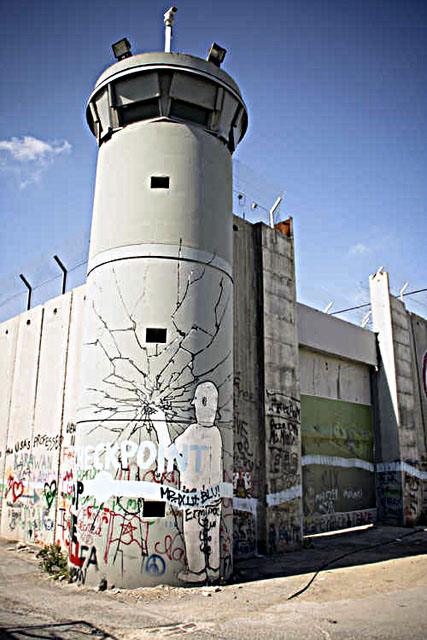
The vast majority of Israelis live in a state of perpetual fear and hatred of Arabs and have hijacked the holocaust in an almost obscene manner in order to justify their own atrocities. By imprisoning the “other” they imprison themselves, most glaringly with the monstrous “Security Wall” now growing apace. This wall eats deeply into Palestinian land so that many farmers can no longer tend their fields and olive groves, and children, the sick and elderly face enormous obstacles in their daily lives. This is not about security; it is naked apartheid.
These days you see graffiti on walls of Arab homes in East Jerusalem or in various Palestinian towns in the occupied territories with the star of David and inscriptions such as “Arabs out” and “Death to Arabs”; eerily reminiscent of what I saw as a child in Germany with the star of David replaced by the swastika and Arabs by Jews. Israel is in a deep moral quagmire and to me only one solution is possible and just: to put Human and Civil Rights above Israeli/Jewish Rights.
It is only by ridding ourselves from the narrow and blinkered view which puts us and our needs above all others that we can attain normality, morality and a sense of justice. To liberate ourselves and live in true freedom and peace we must adopt the idea of one democratic secular state for all its citizens, whoever they are. To me, giving up is not an option and I’ll try to persevere with what Raymond Williams defined as radical: “To be truly radical is to believe in the possibility of good rather than the inevitability of evil”. Hanna Braun, 2003
Addendum,2005 On one of my more recent visits to the Palestinian Territories in September/October 2005 I was invited by the coordinator of ADRID (Association for the Defence of the Rights of Internally Displaced Persons in Israel), Dawoud Badr, to come to his committee’s office in Nazareth, where the networking with 21 similar committees of displaced villagers is growing steadily. He showed me an aerial map of their village prior to its destruction by the Israeli Hagana in 1948.
This happened in spite of the village elders at the time, who previously had agreed with the Hagana commander that they were not going to resist. When the Israeli forces appeared on that fateful day, the mukhtar put out a white flag on top of the minaret, as had been agreed, but the Israelis reneged on their agreement. Subsequently he drove me to the area that had been the village but is now completely overgrown, with boulders lying around and some cactus-fruit shrubs.
The mosque still stands but is in poor repair. Dawoud told me that the villagers’ descendants, now resident in the near-by village of Bashiriyeh, still used to go weekly to pray at the mosque until recently, when the Israeli local authorities prevented them because the building was unsafe. Neither could they obtain permission to repair the mosque. The villagers then took to praying outside the mosque, as a result of which the authorities placed barbed wire around it. Adrid, together with Al-Ard have annual marches and festivals to commemorate their expulsions. They have also petitioned the Govt. to permit them to return to their villages and rebuild them. So far the reply is negative.
At the end of reading Hanna’s Braun memories, you are invited to see this short video: “I am Israel”. This film is not part of Hanna’s memories, it was submitted by another reader.
I am Israel is a film written by Hashem Said on Feb.25.2002 . The Video made by Jihane Al Quds on Sept.4.2009.
Possibly related posts (automatically generated):
The Double Standards of Europe In this photo you can see the Israeli Knesset member Michael Ben Ari (right) of the radical Israeli National Union...
The True Character of Jews shows in Jerusalem These pictures, copied from a Palestinian newspaper, say everything about the character of Jerusalem under the power of the occupying...
Speaking of Jesus Christ, the Messiah - Ephesians 2:4 - For he is our peace who made the two one, and he destroyed the wall that was standing in the middle. - click on picture
Jews' god of Remphan (Saturn - Satan) - its worship is snuff porn
click on picture - and see snuff porn, its service is 911 Israeli terrorism
African genocide - descended from Pharaoh's Opposition to God